Why Digital Products Are the Best Thing to Sell from Home
The business model is almost embarrassingly simple: you create something once, and it can sell indefinitely. No inventory. No shipping. No customer service for every transaction. No commuting. The product lives on a server and gets delivered automatically the moment someone pays for it.
That's different from any physical product business or service business you could run from home. Those require your time every time a sale happens. A digital product doesn't.
The catch is that not all digital products are worth building. Some categories are oversaturated, low-margin, or require skills most professionals don't have. Others are undersupplied and underpriced — meaning people are actively searching for them and willing to pay well for the right one.
Here's a realistic breakdown of the best digital products to sell from home, ranked by what matters: profit potential, time to create, and whether you can realistically build one.
1. PDF Guides and Ebooks
The most accessible digital product for professionals who have expertise to share. A PDF guide is exactly what it sounds like: written expertise, organized clearly, delivered as a downloadable file.
Why they work: People will pay $19–$49 for a PDF that saves them hours of research or costly mistakes. A 5,000-word guide that addresses a specific professional problem — how to negotiate a severance package, how to manage a remote team effectively, how to evaluate a commercial real estate deal — can be worth more than a $200 course to someone who needs that answer now.
Time to create: 1–2 weeks, working in focused sessions. Outline first, then write. Don't aim for perfect — aim for useful.
Best for: Professionals with a specific area of expertise: finance, HR, law, marketing, management, operations. If people regularly ask your advice on a topic, that topic probably has a market.
What makes them sell: Specificity beats breadth. "How to Get Promoted in Corporate Finance" sells better than "How to Advance Your Career." The more precisely the title matches what someone is searching for, the better it converts.
2. Templates and Frameworks
Templates are one of the most underrated digital products to sell from home because they package how you do something rather than what you know. If you have a system that works — a project management framework, a hiring process, a financial planning spreadsheet, a client onboarding template — that system has market value beyond your hourly consulting rate.
Why they work: People don't want to figure out the process. They want the shortcut. A good template is a shortcut you've already stress-tested, packaged for someone starting from scratch.
Time to create: A few days to a week. Most templates are things professionals already use internally — they just need to be cleaned up and made usable for an outside audience.
Best for: Operations professionals, project managers, financial analysts, marketers, HR leads. Anyone whose job involves repeatable processes with clear, measurable outputs.
What makes them sell: The template needs to work. If someone pays $25–$49 for a spreadsheet and it doesn't do what it promises, they'll return it. If it saves them an afternoon and works the first time, they'll recommend it.
3. Workbooks
Workbooks sit between a guide and a course — they require the buyer to do work. That's a feature, not a limitation. The problems most people need to solve — clarifying their career direction, redesigning their finances, defining their goals — aren't solvable by reading. They require reflection, and workbooks force it.
Why they work: Buyers who use workbooks get results. Buyers who get results leave reviews, recommend the product, and buy your next one. Workbooks also carry higher perceived value than passive reading material — buyers feel the investment is "active," which justifies a higher price point ($35–$75).
Time to create: 1–3 weeks. The prompts take longer to craft than the instructions — each question needs to be specific enough to produce useful answers, not vague enough to skip past.
Best for: Coaches, therapists, financial planners, career counselors, consultants — professionals whose work involves guided self-discovery. If your job involves asking clients the right questions, you can package those questions.
What makes them sell: The transformation promise has to be concrete. "Gain financial clarity in 30 days" sells better than "reflect on your finances." Be specific about what the buyer walks away with.
4. Spreadsheet Tools
Spreadsheets are among the best digital products to sell from home for quantitatively-oriented professionals. A good financial model, budget planner, or resource-allocation tool can command $49–$149 from a single buyer — and require almost no ongoing maintenance once built.
Why they work: Buyers don't want to build a model from scratch. They want one that already works, handles edge cases they haven't thought of, and comes with formatting that makes sense. A well-built spreadsheet delivers all of that instantly.
Time to create: Varies by complexity. A solid budgeting template: 2–5 days. A complex financial model or business valuation tool: 2–4 weeks. The more specific the use case, the more you can charge.
Best for: Finance professionals, accountants, operations analysts, real estate investors. If Excel or Google Sheets is a core part of your professional toolkit, you have a marketable asset sitting unused.
What makes them sell: Instructions matter as much as the model itself. A powerful spreadsheet that confuses buyers generates refunds. Include a short guide so buyers can actually use what they paid for.
5. Mini-Courses and Audio Guides
Not courses in the 40-module, learning-management-system sense — but structured, focused learning experiences that fit into someone's day. A 5-video mini-course or a set of 10 audio lessons packages expertise that doesn't fit neatly into a PDF and commands $97–$297.
Why they work: Some knowledge is better taught than written. Tone, emphasis, and nuanced judgment come across differently in audio or video than on a page. If your expertise involves knowing when to use one approach vs. another, audio often communicates that better.
Time to create: 3–6 weeks for a mini-course with 5–8 lessons. Audio-only is faster — no lighting, no editing of visual content. Script it first; the recording usually takes less than a day once the content is structured.
Best for: Professionals with strong communication skills who can explain complex topics clearly. If you've mentored others in your field or given internal training, you already have the source material.
What makes them sell: Length is a liability, not a feature. A 90-minute focused course that delivers one specific transformation sells better than a 6-hour course that covers everything. Cut ruthlessly.
How to Choose the Right One
The best digital product to sell from home isn't the most popular category — it's the one that best matches three factors:
- Your expertise format. Is what you know better expressed through explanation (guide), process (template), reflection (workbook), data (spreadsheet), or instruction (course)? Match the format to the knowledge, not the market.
- The problem you're solving. Is there a specific, searchable problem your product addresses? If you can describe the exact moment someone realizes they need what you're building, you have a product idea. If you can't, keep narrowing.
- What you can actually complete. A guide you finish beats a course you abandon. Pick the format you can realistically build in 1–3 weeks, ship it, and learn from the market before building something more ambitious.
The professionals who build sustainable income from digital products aren't the ones who built the best product on the first try. They're the ones who shipped something, listened to the feedback, and improved it. The first product is how you enter the market. The second product is where the income compounds.
For a step-by-step framework on turning your expertise into a product, read how to turn your professional skills into a digital product. If you're still working full-time and wondering whether this is realistic, the answer is yes — here's how to build it without sacrificing your job.
Everything you need to build and sell your first digital product
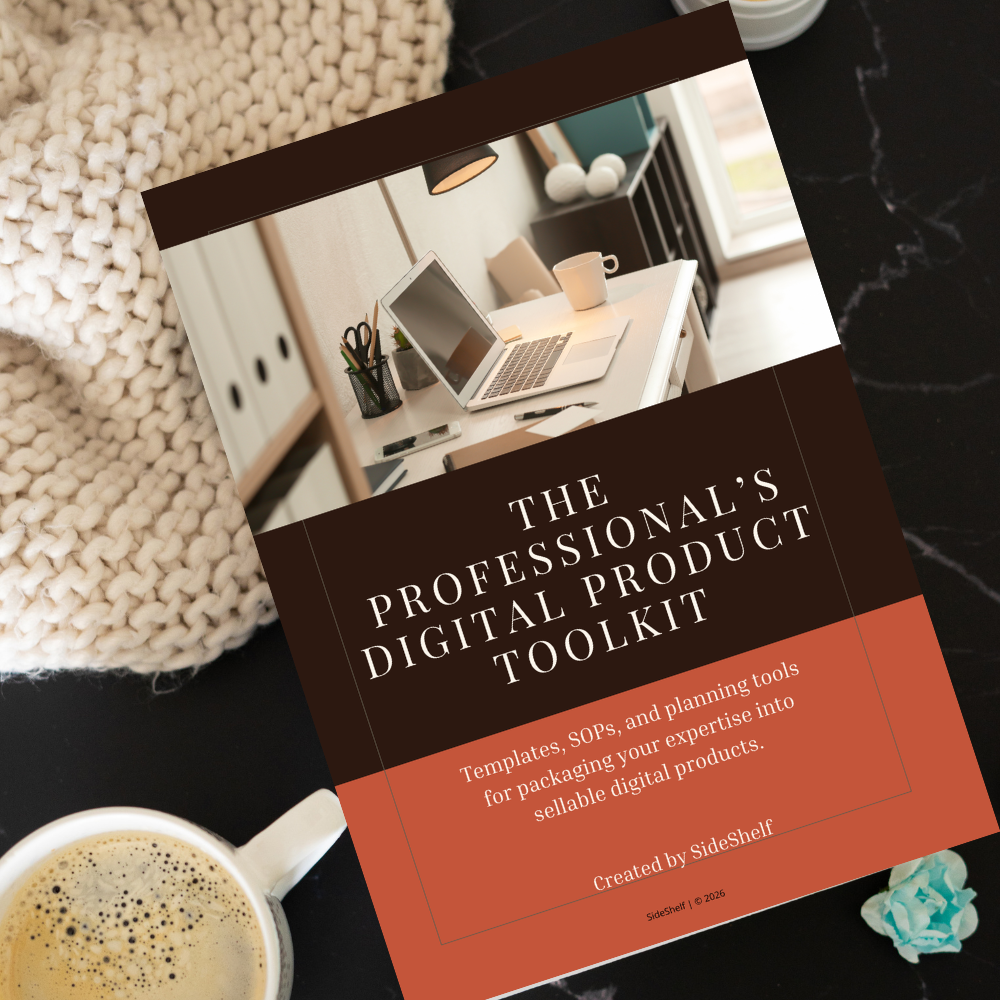
The Digital Product Toolkit gives you the templates, frameworks, and step-by-step system for creating a digital product from scratch — from choosing the right format to pricing it, packaging it, and making your first sales. Built for professionals who want to skip the learning curve.
Get The Digital Product Toolkit — $39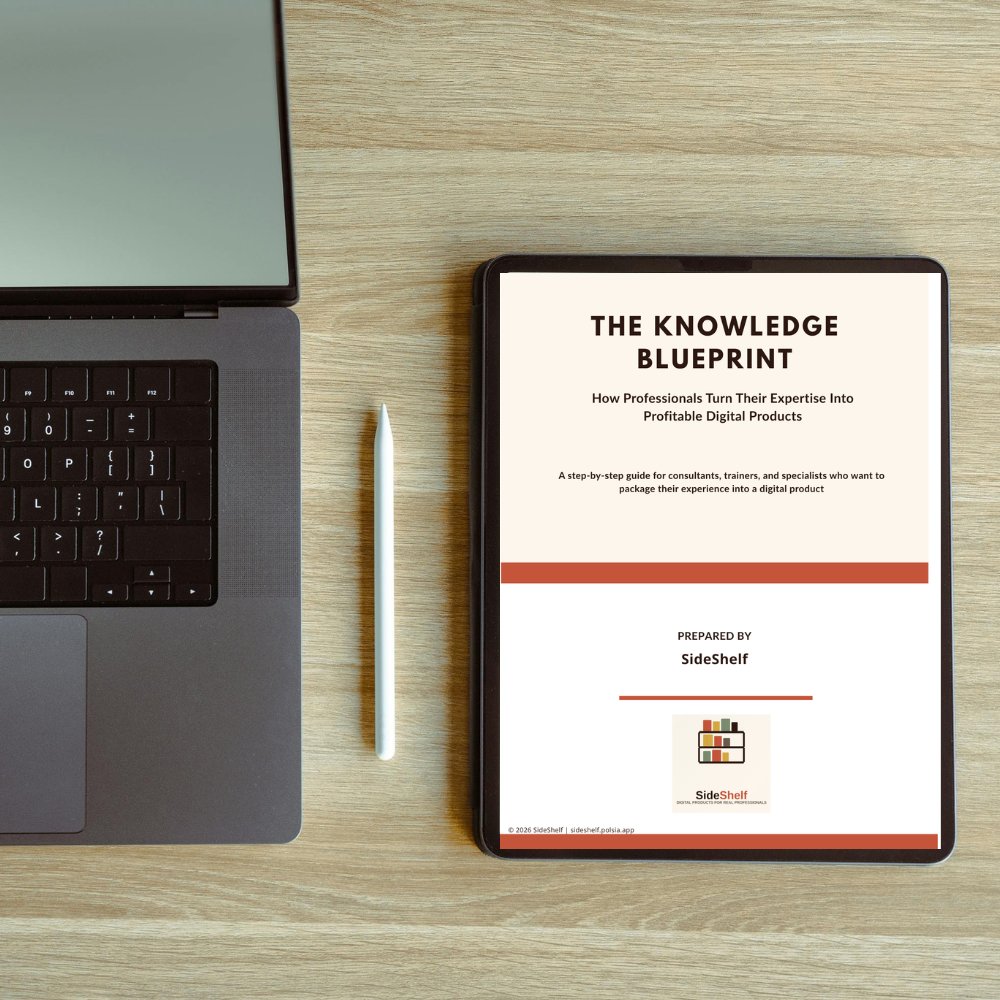
Free Tips
Get free tips on building side income
Practical strategies for busy professionals who want to earn more — delivered straight to your inbox.
Explore the full SideShelf collection
Browse All Products