The "Experience" You Think You Need vs. The Experience You Actually Have
Here's the sentence that stops most people: "I don't have experience creating digital products."
That's almost certainly true. And it doesn't matter at all.
The experience that creates a digital product worth buying isn't experience making digital products. It's experience solving a specific problem — in the real world, for real people, with real consequences. That's the experience you've probably been accumulating for years without realizing it had monetary value.
A 15-year HR manager knows how to navigate difficult conversations in a way that books can't fully capture. A former accountant understands tax strategy in ways that save clients thousands. A seasoned project manager has a framework for managing scope creep that juniors desperately need. None of those people need to know how to make a digital product. They need to know how to package what they know.
That's the distinction: you don't need product-creation experience. You need a system for turning professional expertise into something downloadable, useful, and worth paying for.
What "No Experience" Actually Looks Like in Practice
Let's be specific about what you're actually worried about.
Design skills? Your first digital product doesn't need to be designed. A well-organized PDF in Google Docs will sell. A clean spreadsheet template will sell. A checklist on a white background will sell. Design matters at scale, not at launch.
Tech skills? The technical barrier to creating a digital product is lower than it's ever been. You need a word processor, a PDF export, and a way to take payment. Nothing more. You don't need to build a website, set up e-commerce, or write a line of code to sell your first product.
Writing skills? You don't need to be a writer. You need to be clear. The professionals who create the best-selling digital products write the same way they'd explain something to a smart colleague over lunch — not academic, not polished, just clear and useful.
Marketing experience? You don't need it at launch. Your first 20-50 customers will come from your professional network: people who already know you, already respect your expertise, and are already curious about what you know. That's a real distribution channel that requires zero marketing experience to use.
Step 1: Find the Problem People Already Pay to Solve
Before you build anything, identify a specific problem your expertise addresses — one that people are actively trying to solve. Not a vague "I could teach people about project management." Something specific.
The fastest way to find it: scan your email inbox from the last 12 months. What questions do colleagues, former clients, or mentees repeatedly ask you? What are people in your field getting stuck on that you solved years ago? What did you have to figure out the hard way that you could now shortcut for someone else?
The best digital product ideas aren't usually the flashy ones. They're the ones that answer questions people are already paying consultants or courses to answer — but that you could package more accessibly, at a fraction of the price.
Write down 5 ideas. Don't filter yet. You'll evaluate them in the next step.
Step 2: Pick the Format That Matches What You Know
Digital products come in many formats. The right one isn't determined by what's popular — it's determined by what best delivers your specific knowledge.
PDF Guide or Ebook: Best for conceptual knowledge that benefits from explanation — frameworks, mental models, strategic guidance. 4,000–10,000 words. Sells well at $19–$49.
Templates and Frameworks: Best for process knowledge. If your expertise is in how you do something — a workflow, a system, a checklist — a template lets people use your exact approach. $15–$39.
Workbooks: Best for transformational knowledge that requires the buyer to apply it to their own situation. Financial planning frameworks, career assessment tools, goal-setting systems. $25–$75.
Spreadsheets: Best for quantitative expertise. Budgeting calculators, project resource planners, financial models. High value-to-effort ratio. $29–$149.
Pick the format that would most efficiently deliver the solution to the problem you identified. If your expertise is in how you think about something, write it. If it's in how you do something, template it.
Step 3: Outline Before You Write a Single Word
The #1 reason people get stuck building their first digital product is starting with a blank page.
Don't write yet. Outline first. Answer these four questions:
- What is the core problem this product solves? One sentence. If you can't answer this, you haven't picked a specific enough topic.
- What does someone need to understand or do to solve that problem? List 5–8 components. These become your sections or chapters.
- What's the transformation? Where is the buyer before they use this, and where are they after?
- What would make someone say "this was worth every dollar"? Include that thing — the specific framework, the exact template, the real example from your own experience.
A solid outline turns a blank page into fill-in-the-blanks. You're not writing from scratch anymore — you're elaborating on a structure you already mapped.
Step 4: Build It in the Simplest Format Possible
This is where most people overthink themselves into never shipping.
For your first product: use Google Docs, export to PDF. That's it.
Your buyers aren't paying for the PDF. They're paying for what's inside it. A beautifully designed guide with thin content gets refunded. A plainly formatted guide with genuinely useful, specific, expert knowledge gets recommended. Write clearly, organize logically, be specific, and ship.
You can upgrade the design in version 2 — after you've confirmed people actually want what you built.
Need a starting point? Read how to turn your professional skills into a digital product for a framework on identifying what to package first.
Step 5: Price It Based on the Problem, Not Your Confidence
First-time digital product creators almost always underprice.
The instinct is: "I don't know if people will buy this, so I'll price it at $5 to lower the barrier." This is backwards. A low price signals low value and attracts buyers who expect little. A $29–$49 price signals this is a real solution to a real problem — and attracts buyers who are actually motivated to use what you built.
Price based on the value of the problem being solved, not your confidence in yourself as a product creator. If your expertise would cost $300/hour to access via consulting, a $39 PDF that delivers the core of that knowledge is a significant discount — not an expensive purchase.
Step 6: Sell to 10 People Before You Build a Funnel
You don't need marketing experience for your first 10 sales. You need a list of 10–20 people who might benefit from what you built.
Write a message — three sentences: What problem does this solve? What's included? What does it cost? Send it personally to 10–20 people who would benefit. Don't blast a list. Don't post on LinkedIn yet. Just send the message and see who buys.
Your first 10 sales will teach you more than any marketing course: what people actually want, how they describe the problem, what questions come up. That feedback is how you improve the product and refine how you talk about it — before you spend any energy on marketing at all.
What Happens After the First Sale
The first sale changes everything. Not because of the money — though $29 or $39 is real confirmation — but because it proves something: people will pay for what you know.
That proof removes the uncertainty that stops most professionals from ever building anything. You now have a product that exists in the world, a customer you can ask for feedback, and evidence that your expertise has market value.
From that foundation, you can improve the product, increase the price, expand the topic, or build a second product in an adjacent area. The compound effect of digital products isn't the first $29 — it's what happens when you've built 3–5 products that each earn steadily, all built from the same professional expertise, for the same audience.
No experience creating digital products required. Just the willingness to start with what you already know. If you're wondering whether a full-time job is actually a barrier to building this, the answer is: it's not — read how to create your first digital product while working full-time.
The system for building your first digital product
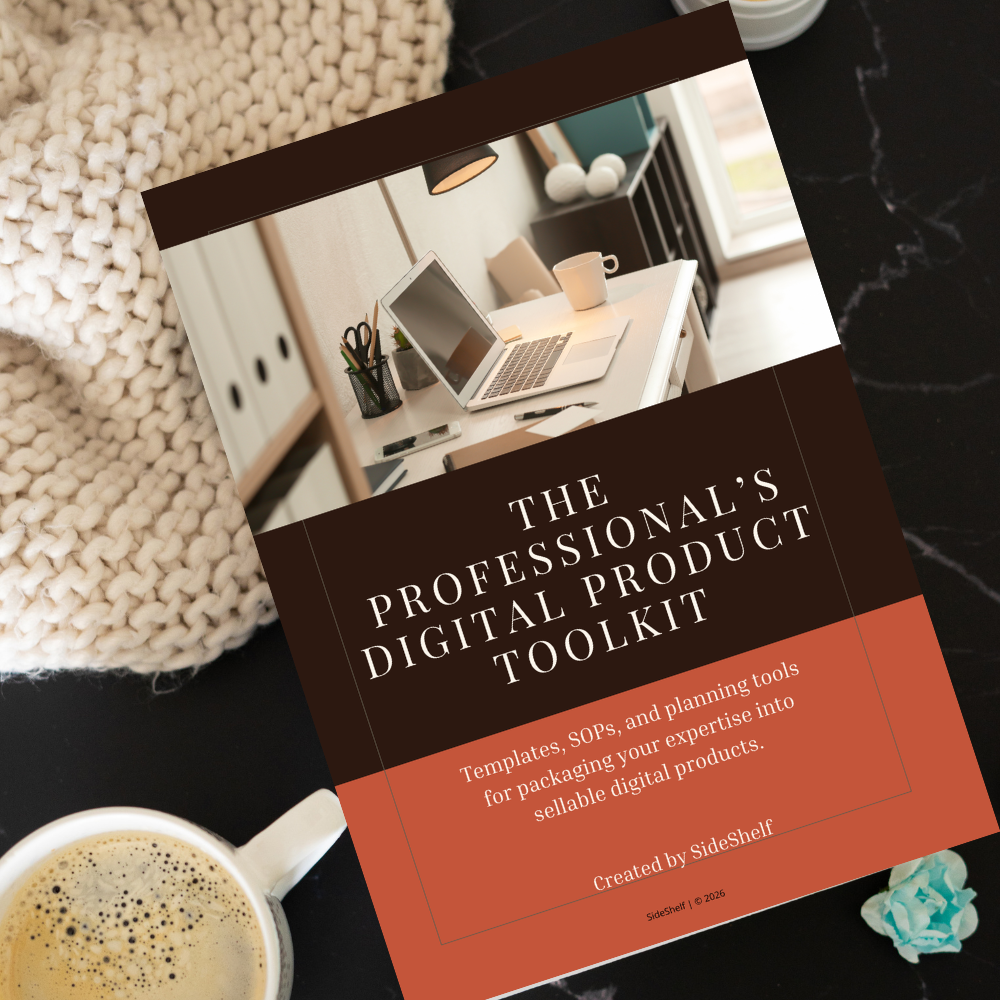
The Knowledge Blueprint is a step-by-step guide for professionals who want to turn their expertise into income — without quitting their job, learning design, or becoming a content creator. It covers product selection, structuring your knowledge, pricing, and getting your first customers.
Get The Knowledge Blueprint — $29
Free Tips
Get free tips on building side income
Practical strategies for busy professionals who want to earn more — delivered straight to your inbox.
Explore the full SideShelf collection
Browse All Products