The Expertise Paradox
Here's the frustrating irony of digital products: the people who have the most to offer are often the last ones to create anything.
Newer professionals build courses, write guides, and package their knowledge constantly — sometimes about things they barely understand yet. Experienced professionals sit on 20 years of hard-won expertise and never ship a product because they're too busy, too skeptical, or too convinced that what they know isn't special enough.
It is special enough. The issue isn't the knowledge. It's the packaging.
This guide is the practical path from "I have experience" to "I have a product."
Step 1: Stop Looking for the "Perfect" Idea
Most professionals who want to create a digital product spend weeks — sometimes months — searching for the perfect idea. Something completely original. Something no one has done before.
This is the wrong search. Digital products don't need to be original. They need to be better for a specific person.
There are already dozens of guides on project management, financial planning, leadership, and client communication. The market isn't saturated — it's full of generic advice for a broad audience. Your job isn't to invent a new category. Your job is to serve a specific slice of that audience with the depth and specificity they can't find anywhere else.
The professional with 20 years in corporate legal doesn't need a new idea. They need to ask: what do I know about navigating corporate legal that would have saved a junior attorney ten frustrating years of mistakes?
Step 2: Find Your "I Already Knew That" Moment
The best digital products are built around knowledge that feels obvious to you but is invisible to the people who need it most.
Think about the last time a younger colleague, a client, or someone in your network asked you for advice — and your answer felt almost embarrassingly simple to give. The kind of advice that took you years to learn but comes out effortlessly now.
That's your product idea.
A few questions to surface it:
- What do you know now that you wish you'd known at 30? The gap between where you are and where you were is the product.
- What mistake do you see smart people make repeatedly? Your pattern recognition after two decades is a product.
- What system or framework have you refined over years that other people borrow from you? Your proprietary process is a product.
- What question does your team, your clients, or your network always come back to you for? Recurring demand is a product signal.
Step 3: Choose the Right Format
Before you build anything, decide what form your product takes. This matters more than most people realize because the wrong format will make the project feel impossible.
Guides and eBooks ($19–$49): The lowest barrier to entry. Write what you know, format it clearly, export as PDF. Ideal for specific, tactical knowledge that helps someone accomplish something concrete. Works best when the topic is focused, not broad.
Templates ($19–$79): Frameworks, spreadsheets, documents, or systems that your buyer can immediately use and customize. High value, relatively low effort to create if you've already built them for your own work. Works best when you've refined a process that others could replicate.
Trainings and Mini-Courses ($47–$197): Video or written walkthroughs of a specific skill, process, or approach. More effort to create, but creates more perceived value and allows for deeper teaching. Works best when the topic requires explanation, demonstration, or a step-by-step walkthrough.
Start with a guide or template. You can always build upward from there.
Step 4: Write for One Person
The most common reason experienced professionals write content that doesn't connect: they write for everyone.
Before you write a single sentence, name your reader. Not a demographic — a person. Someone specific, even if fictional. What's their job title? What problem are they facing this week? What have they already tried that hasn't worked? What would their life look like if they solved this problem?
When you write for that person, your content gets specific. Specific content solves real problems. Real solutions earn real money.
"Professionals who want to improve their leadership skills" is not a person. "A 38-year-old operations manager who just got their first team of 6 and has no idea how to give feedback without crushing morale" — that's a person. Write for that person.
Step 5: Set a Scope That You Can Ship
The graveyard of digital products is full of ambitious projects that were 70% complete when the creator ran out of energy.
Scope your first product to something you can complete in 30 days of evenings and weekends. Not a comprehensive guide to everything you know — a focused guide to one specific problem you solve well.
Aim for 3,000–8,000 words for a guide. 5–10 templates for a template pack. 60–90 minutes of video for a mini-training. Something a reader or viewer can consume in one sitting and walk away feeling like they got more value than they paid for.
You can always build the next product. Ship this one first.
Step 6: Price It Like a Professional
Most first-time creators underprice their products because they undervalue their expertise.
If your product saves someone 10 hours of work, it's worth more than $10. If it prevents a costly mistake, it's worth more than $20. If it helps someone get a promotion, land a client, or solve a problem they've been stuck on for months — price it accordingly.
For professionals selling to other professionals, the $29–$97 range is the sweet spot for guides and templates. It's not trivial (which would make buyers skeptical), and it's not a major commitment (which would require an elaborate sales process).
Price with confidence. Experienced knowledge has real value.
Step 7: Launch Before You're Ready
This is the step that separates professionals who have a digital product from professionals who are planning to have one.
Your first product won't be perfect. The formatting will be slightly off. You'll think of things you should have included. You'll wish you'd explained something differently.
Ship it anyway.
The feedback you get from real buyers — even a handful of them — will tell you more than six more months of refining in isolation. Real buyers tell you what they needed more of, what was confusing, and what they valued most. That information is how you make the next version — and the next product — better.
Done is worth more than perfect. Ship it, learn from it, improve it.
The Only Resource You Actually Need
Twenty years of experience is the hard part — and you already have it. The rest is packaging, positioning, and finding the right buyers. That's learnable. That's a process.
The step-by-step system for packaging your expertise
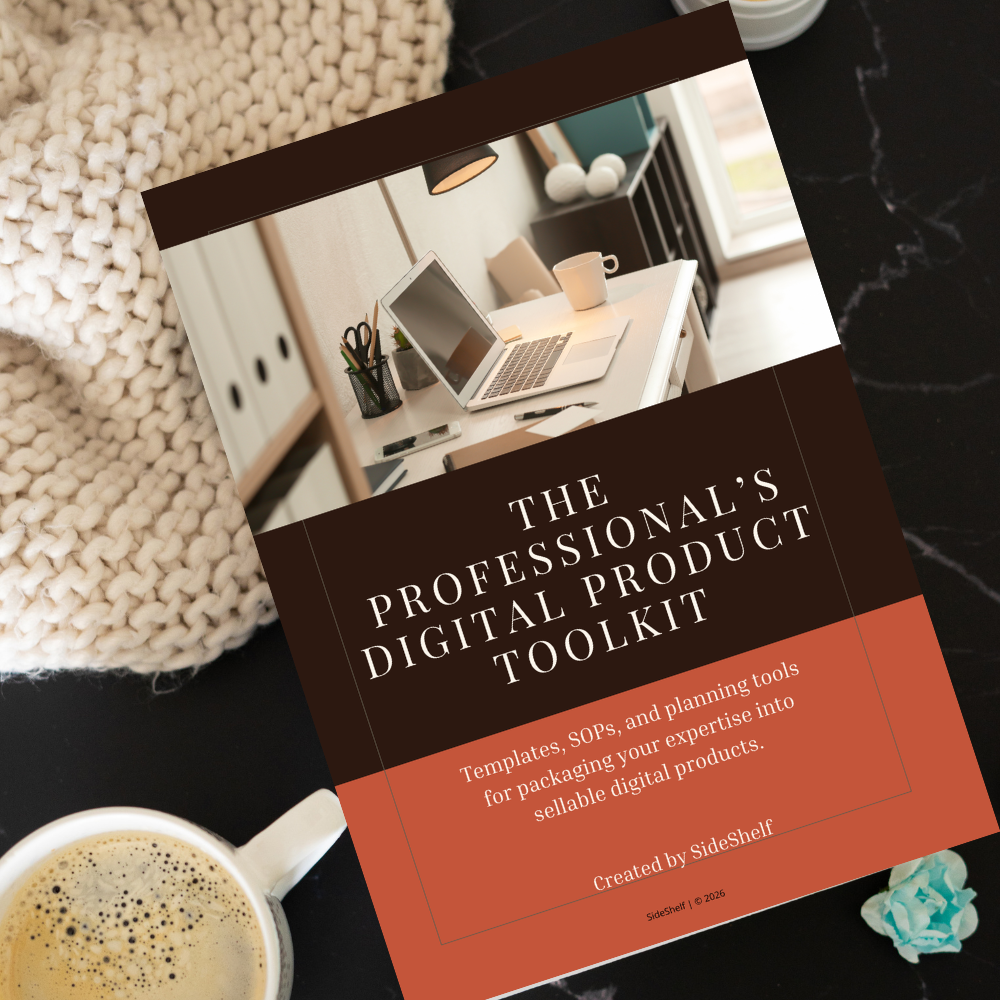
The Professional's Digital Product Toolkit gives you everything you need to take your expertise from "idea" to "product for sale" — including the research framework, the writing templates, the pricing guide, and the launch checklist built specifically for 9-to-5 professionals.
Get the Toolkit — $39
Free Tips
Get free tips on building side income
Practical strategies for busy professionals who want to earn more — delivered straight to your inbox.
Explore the full SideShelf collection
Browse All Products