Why Most Passive Income Advice Fails Professionals Over 40
Most passive income content is written for an audience with a lot of time and very little expertise. Drop-shipping, affiliate marketing, YouTube channels, crypto trading — the strategies that dominate the passive income conversation require months of grinding before they pay anything, and they work best when built at scale with unlimited energy.
Professionals over 40 are in the opposite situation. You have deep expertise and limited time. Your professional network is extensive. Your credibility is established. Your tolerance for "hustle for 18 months with no return" is reasonably low — and that's a rational position, not a personal failing.
The passive income strategies that work for you aren't the ones that require rebuilding from scratch. They're the ones that leverage what you've already built over a 15–20 year career — and can generate real income without consuming your weekends.
Here's what that actually looks like.
1. Digital Products Built From Your Professional Expertise
This is the highest-leverage passive income opportunity for experienced professionals, and the most underutilized one.
The idea is straightforward: take the knowledge you've accumulated over your career — the frameworks you've developed, the mistakes you've made and corrected, the shortcuts you've found, the problems you've solved repeatedly — and package it into something downloadable. A PDF guide, a template library, a workbook, a spreadsheet tool.
Once it's built, it sells around the clock. You're not trading time for money. You're selling access to expertise you've already developed.
Why it works especially well after 40: The quality of professional knowledge increases nonlinearly with experience. A 25-year-old can write a blog post about project management. A 45-year-old can write a guide about navigating a failing project with executive pressure from three different directions — a situation they've actually been in and survived. The second product has far more value and far less competition.
Realistic income at scale: $1,000–$5,000/month from 2–4 products, once you've established a distribution channel. First-product revenue typically takes 3–6 months to become consistent. Not overnight — but genuinely passive once the product is live and indexed.
For a step-by-step breakdown of exactly what types of digital products sell best, see the best digital products to sell from home.
2. Licensing Your Professional Frameworks
If you've built a proprietary methodology, process, or tool in your field, there's a licensing market you probably haven't considered. Companies pay for the right to use frameworks they didn't build — especially when those frameworks are proven, documented, and repeatable.
This is different from consulting. You're not paid for your time. You're paid for access to a system you created once.
The most common form: licensing a toolkit, assessment, or curriculum to HR departments, training companies, or consulting firms who integrate your framework into their own practice. Licensing deals typically range from $2,000–$20,000 per year per licensee, depending on the framework's scope and the size of the organization.
What's required: A documented, repeatable methodology that produces measurable results. If you've been doing something the same way across multiple clients or situations and it consistently works, it can be licensed. If it lives only in your head, the first step is documentation — then licensing follows naturally.
3. Dividend-Focused Investment Portfolios
Not a new idea, but dramatically more accessible than it was 20 years ago. A dividend-focused portfolio in a low-cost brokerage generates income proportional to the capital invested — and requires almost no active management after the initial setup.
The realistic math: A $200,000 portfolio in dividend ETFs (SCHD, VYM, or similar funds) at a 3.5% yield generates approximately $7,000 per year, or about $580 per month. That's not retirement income on its own, but it's meaningful supplemental income that grows as you reinvest dividends and continue adding to the portfolio.
Why it matters for professionals over 40: You likely have capital to invest that a 25-year-old doesn't. The 20-year compound growth horizon is still meaningful. A portfolio started at 42 with consistent contributions reaches a fundamentally different place by 62 than one started at 55. Time is still on your side — but it's not unlimited. The best moment to start was 10 years ago. The second-best moment is now.
4. A Published Book (Not for Royalties — For What It Generates)
A published book generates two income streams, and only one of them is royalties.
Direct royalties from professional books are modest — most earn $5,000–$20,000 over their lifetime from book sales alone. The real value is indirect: the book becomes a permanent credential that attracts consulting clients, speaking engagements, and corporate training requests at rates that dwarf the royalties themselves.
The indirect income stream is what makes a professional book a passive income play. A book published in 2026 can generate consulting leads in 2031. It's a marketing asset that keeps working without your involvement.
Self-publishing vs. traditional: For professionals building a business around their expertise (rather than trying to become full-time authors), self-publishing is almost always the better economic path. You retain all rights, set your own pricing, and get to market months faster. A well-produced self-published book on a specific professional topic routinely outperforms traditionally published books in total economic value.
5. High-Yield Savings and Fixed Income
The least exciting option on this list — and one of the most reliable ones.
High-yield savings accounts and short-term treasury bills now offer yields that make holding cash in a checking account feel almost negligent by comparison. On $50,000 at a 4.5% yield, that's $2,250 per year with essentially zero risk and full liquidity.
It's not a wealth-building strategy on its own. But for emergency funds and short-term reserves, there's no reason to leave that yield on the table. And for professionals with significant savings accumulated over a career, the income from cash equivalents can meaningfully supplement earned income while you build something more durable.
It's also a useful mindset shift: seeing your savings as something that generates income — not just a reserve you spend down — is the first step in thinking like someone who builds wealth rather than earns it.
What All of These Have in Common
None of them require you to quit your job, rebuild your professional identity, or hustle for 18 months before seeing results. They all require one of two inputs: capital you've already accumulated, or expertise you've already developed.
That's the specific advantage of being over 40 with a successful career behind you. The raw materials for building passive income — knowledge, network, credibility, capital — are things you've been accumulating for decades. You're not starting from scratch. You're converting what you've already built into income streams that don't require your constant presence.
The professionals who build meaningful passive income before 50 aren't the ones who worked harder. They're the ones who took seriously — for the first time — that what they know has more market value than their current salary implies, and that packaging it correctly changes the math entirely.
If you're starting with the digital products path, here's why professionals over 40 have a specific structural advantage in this market. For a framework on identifying exactly which of your skills to package first, read how to turn your professional skills into a digital product.
Turn what you already know into passive income
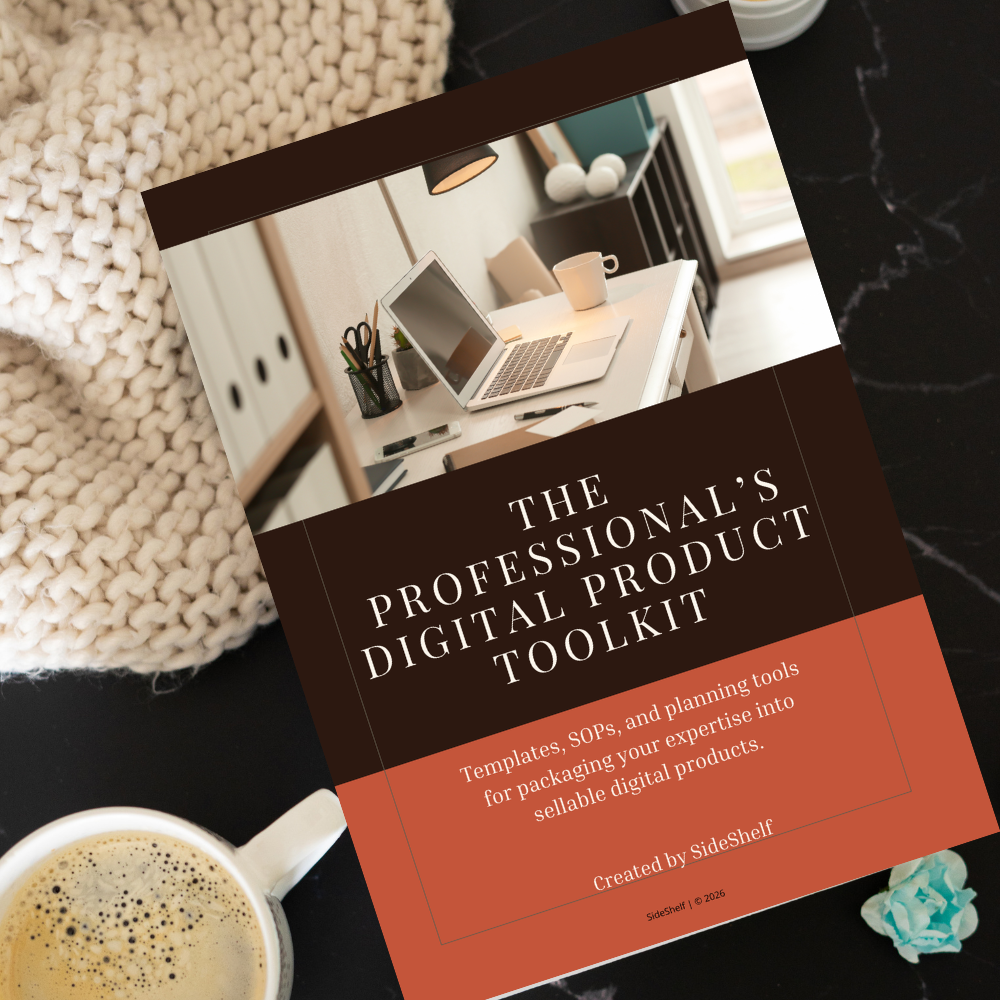
The Knowledge Blueprint is a step-by-step guide for professionals who want to create a digital product from their expertise — without quitting their job, learning design, or figuring it out through trial and error. It covers product selection, pricing, structuring your knowledge, and getting your first customers.
Get The Knowledge Blueprint — $29
Free Tips
Get free tips on building side income
Practical strategies for busy professionals who want to earn more — delivered straight to your inbox.
Explore the full SideShelf collection
Browse All Products